Thursday, November 3, 2011

To the South

3 November, 2011
Damascus Street
Abdoun, Amman Jordan
4:00 PM

Greetings,


I just got back last night from a 5 day tour of the major landmarks in the south of Jordan. I am now “Studying” for Saturday’s Arabic final (and by “studying for Arabic” I mean “blogging and trying to forget about Arabic”). 

Before I begin, let me say that this trip was by far my favorite thing that I have done so far in Jordan, with the possible exception of the Badia homestay. It was simultaneously adventurous and relaxing encompassing the entire gauntlet of travel: desert, coast, ocean, mountain, tents, camels, and a 5 star stay in a 5 star hotel. I did not want to come home and face a month of research (and the aforementioned Arabic final)

Day 1: Karak Castle and Dana

The first stop on our tour was at Karak castle, an ancient structure that has been standing since the time of the crusaders. The architecture is an interesting mix of Middle Ages Christian construction and the finer Ottoman and Mamluk design. The hallways are winding and cavernous, and I more than once mentioned that it was cool to wander around an ancient, ruined castle on Halloween weekend, even though I don’t celebrate Halloween because I’ll go to hell if I do.


Karak Castle  

After Karak castle we hopped back in the bus and drove for a while until we reached the perfect picnic location. Cultural note: any spot can be a perfect picnic spot. I frequently seen Jordanian/Bedouin families parked on the side of the road with tea pots bubbling on camp stoves behind their cars. Today, we got to be those Bedouins. We piled out of the bus, spread some mats on the ground, and ate cucumbers pastries, and Pepsi on the side of the road, overlooking the valley.

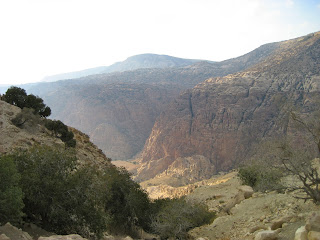
The bus then continued down an overly windy valley that made all of us feel shway (a little) ill, before stopping in the cold, clear air of the Dana Biosphere reserve. This is truly one of the most beautiful places I have ever been, just behind my parent’s home in Northern California, Loma, and about tied with the Scottish highlands. 

We spent about 2 hours hiking along ridgelines and through groves of pomegranates, olives, apricots, and poplar trees. On the hike I saw a baby camel AND a baby donkey who were totally BFF. Too dang cute.  
 Seriously. How cute is that? 

The second part of the hike was quite strenuous; we picked our way through brambles and down steep embankments. It was glorious to be out in nature in the clean, fresh air. We had a naturalist for a tour guide who gave us a lot of information about the preserve. If I ever come back to this part of the world I would like to spend a solid week camping, hiking, and backpacking here.
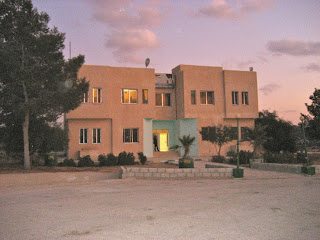
We stayed the night in a youth hostel that used to be an orphanage, though I claimed it felt more like an mental institution. It was COLD in that place, but luckily I packed my polar bear jacket, so I survived pretty well. I also came down with one of my famous headaches, so I went to bed at 7:30 and didn’t wake up until 7:00 the next morning.
The Orphanage (not a real name) 

Day 2: The Red Rose City

At 9:00am we left The Orphanage and headed up the mountain to see the ancient city of Petra. If you have ever seen Indiana Jones and the Last Crusade or Lawrence of Arabia then you may have some idea of what Petra is like, but let me tell you right now, you are wrong. It is mind blowingly more than that. The city was built by an ancient civilization called the Nabateans. They controlled the region when it was a key route for trading between Egypt and Arabia to the south and India, China, and Europe to the north. They built an elaborate network of tunnels, caverns, and sculptures that incorporate Arabic, Greek, Byzantine, Turkish, and Roman artwork. Most of the freestanding structures have fallen, but the ones carved into the cliff face are beautifully preserved.

 The Siq is the ancient road leading into the city. The wall like structure to the left is the plumbing system that the Nabeteans designed to carry water to all of the city. 
 At the end of the Siq is the Treasury, the most famous structure in Petra 

I spent 5 hours wandering around Petra, and it still wasn’t enough. The pictures can’t adequately capture the brilliance of the city. It was far and away one of the coolest things I have ever seen. Way better than the pyramids.
 There are dozens of these sorts of dwellings built into the rock face. 
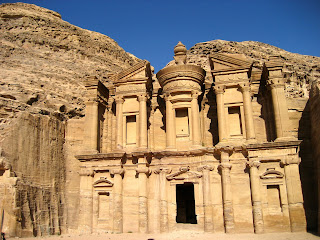
 The Monastery- the second most famous structure. It was used as an actual monastery by Monks during the Byzantine period, but was built as a tomb by the Nabateans. 

We spent the night at the Petra Marriot, which was one of the nicest hotels I have ever stayed in. The beds were like sleeping on clouds, especially compared to the concrete slab that serves as my bed in Amman. Alexandra and I were so thrilled that we only left the room once, for dinner (which was the best meal I’ve had since coming to Jordan) and then ordered tea to the room and watched terrible movies in our beds before falling asleep at 11:00. Not exactly cultural immersion, but so so relaxing.

Day 3: The Desert Camp

After we checked out from the hotel we made a total 180 in living conditions. We packed up the bus and drove to Wadi Rum, an area of Jordan that looks exactly like Luke Skywalker’s home planet. We unloaded at a small camp in the desert, which I affectionately named our Terrorist Training Camp. 

Home sweet tent 

We took off for a two hour Jeep tour of the desert. The sand dunes and rock formations were remarkable. I have huge issues with sand, especially when it touches my feet, so I didn’t scamper about as much as some of my classmates, but I had a great time seeing some of the spots that Lawrence of Arabia camped during the Great Arab revolt, and drinking tea with some Bedouins we met along the way.
 Our carriages 

Temperatures drop quickly in the desert, and by the time we got back to the TTC it was getting cold. We moved into our tiny tents, added layers, and sat around a campfire for a while we waited for our dinner. Dinner was traditional Bedouin style, cooked in a giant pot covered with coals and buried in the sand.  After dinner we sat around the fire and talked, played “would you rather” for hours, and roasted marshmallows that the camp director gave us. We ended the night reading Edger Allen Poe allowed, because it was Halloween, after all.

Wadi Rum near sunset. 

The night was spent shivering in our tents. Ali and Eve, my two tent mates, didn’t sleep well due to the cold and a dog barking, but I slept like a baby. 

Day 4: Ships of the Desert and Actual Ships

We woke up early the next morning and took a camel ride through the desert. This is more traditional than the Egypt camel ride, which was pretty much designed just for tourists, but the men who led our tour were real Bedouins whose families have been raising camels for generations.  

After a delicious breakfast we packed up and left the TTC. The ride to Aqaba was short and pleasant. Aqaba is a pretty, coastal, city that reminds me of the San Diego of the Middle East. We stopped at the hotel for a short rest and then boarded a small yacht to sail on the Red Sea. The water was brilliantly clear and blue. It was very relaxing and pleasant to sit on a boat in that blue water and look around. At one point we could see the coast of Palestine, Egypt, Jordan, and Saudi Arabia all at once. How many people can say that? My classmates snorkeled, but I was cold and didn’t much fancy being salty and wet all day, so I stayed on board and took pictures.
 The coast of Saudi Arabia 

For dinner we walked downtown and ate pizza and gelato (I was sick of shwarma and falafel) and looked around. Aqaba is a special economic zone, which mostly means that they import a lot of cheap Chinese stuff to sell to tourists.

Day 5:  Home again

The day started slow with Ali and I walking down to the coast of the Red Sea and sitting for 45 minutes drinking tea in a café. Cultural note: There is not much regulation here, so a lot of people with property set out a few tables and chairs, buy a stove and some hookas, and call it a café. We saw some gypsies with dirty, un-panted children walking along the coast. The Jordanian woman at the table ext to us was very concerned that we not think that they were Jordanian, and spent a lot of time telling us that they were “No Urdoni” in a combination of her broken English and our broken Arabic.

A sign I found in downtown Aqaba. Apparently they had a problem with this. Maybe we should get some in Ocean Beach. 

After tea we walked along the shore until we found a cool little store that sold hand crafts made by local women. The store was run on microcredit loans and worked to raise money for women in the region. I bought a few things. They were too expensive, but I like to have something that is made locally, not in China, and goes to a good cause.


I got home last night to a host family that is ill (probably my fault) and frantic getting ready for 3eed, and a month of research ahead of me, but rested and relaxed from such a great trip. 

More soon, 
B 

Wednesday, October 26, 2011

The Egypt Story

Welp, I got sick again. Way way sicker than last time, but here at last, for your reading and viewing pleasure, is the story of my trip to Cairo. It is, if possible, longer than the Badia story, but the pictures are cool.


Day 1:
On Wednesday last I got up at 4:30 to leave for Egypt. I had not slept very many hours because my host sister was studying in our room with the light on. At 2:00am I told her to go study else ware, since I had to be up in an hour and a half.  The entiregroup met at SIT bright and early, and somehow we managed to negotiate 33 students, and 3 chaperones to the airport, through customs, and onto the plane. 

When we got to Cairo the first thing I noticed was how green everything is. Amman is the driest, brownest, city I have ever set foot in. Cairo looks like Minnesota compared to it. The men at immigration told us that they were happy to see tourists in Egypt again. The country’s economy is strongly tourist based, and after the revolution things have dropped off dramatically.

We checked into the Pharaoh Egypt hotel, which is in Giza, slightly east of Cairo. A lot of the girls complained that the bathroom was too small and dusty; the halls were dark, and the rooms Spartan. It did feel a little like summer camp (Alexandra, Hannah, and I had three twin beds crammed cheek to jowl in out room) but I pointed out that if they wanted to stay in an American hotel, they should have stayed in America.
The Pharaoh Egypt Hotel 

We were supposed to have a lecture that evening about the Arab spring, but the lecturer had recently had surgery, and in typical Arab fashion had not informed Dr. Raed that he would not be able to meet with us. This left us with a few hours of free time before dinner. Alexandra and I wandered around Giza with a few other people. We weren’t in a heavy tourist area, so most of the places we saw were targeted toward upper middle class Egyptians. We finally stopped for tea and argeela. The café was really cool, at the top of a hotel in Giza. It was a little silly leaving one hotel for another, but the place was nearly empty and offered sweeping views of Cairo.

Cairo is HUGE. 7 million people live in Cairo, a million more than live in the entire country of Jordan. The traffic is absolutely atrocious. Picture Sunset Cliffs Blvd at noon on the on Fourth of July, but all the time everyday, no matter where you are trying to go.


Cairo Traffic 

For dinner that night we had Kushori (pronounced cush-ore-i), which is a traditional Egyptian dish. As Dr.Raed explained it is “the food of the poor” It is rice, pasta, lentils, chickpeas, and tomato sauce that you mix together and eat hot with a chili sauce. Not everyone liked it, but I thought it was delicious.

Day 2:
In the morning we had a lecture about ancient Egyptian civilization with a professor from Cairo University.  After that we went to see the Cairo citadel and Mosques of Muhammad Ali and Sultan Hassan. Muhammad Ali controlled Egypt after the fall of the Ottoman empire. The citadel is not much to look at, but it did give great views of Cairo. We females weren’t even asked to cover our hair, though we all did have to take off our shoes.

The second mosque was beautiful, and we got to hear an imman chant part of the Q’ran, which was unbelievably cool. Our tour guide sat with us for a while afterwards and told us some of the aspects of Islam, which we all knew because most of us are Middle East studies majors and even those that are not have lived in Jordan long enough to figure it out. It was ok though, and I’m sure she is used to giving lectures to groups of tourists who have not spent much time in the Middle East


After the mosques we went to Khan al Khalili Bazaar, one of the oldest markets in Cairo. There was a time where the artisans made all their goods right there and you could watch them make it, but now a lot of the stuff is made in China. I explored a little with some other students, and we found some really cool shops off the beaten path where people still make their own goods.

The merchants there were pretty crazy. They would go to any lengths to get your attention so you would buy something. My favorite was "Excuse me! (I look away pointedly) No! I have a wife, I just want your money." I told him I appreciated his honesty. I know these people have to make a living, but it was insane the amount of shouting and haggling that went on. I did manage to argue down a good price for some scarves for my roommates and Christmas presents for my brothers. 

For dinner that night we went to a place called Nile Action where they had  had a lion cub that they were taking pictures with. They would let people hold the cub and then take a picture of them, at the cost of 35 Egyptian pounds (about 6 USD).  I don’t like wild animals being handed around to tourists, so I did not have my picture taken holding a lion.

Day 3:
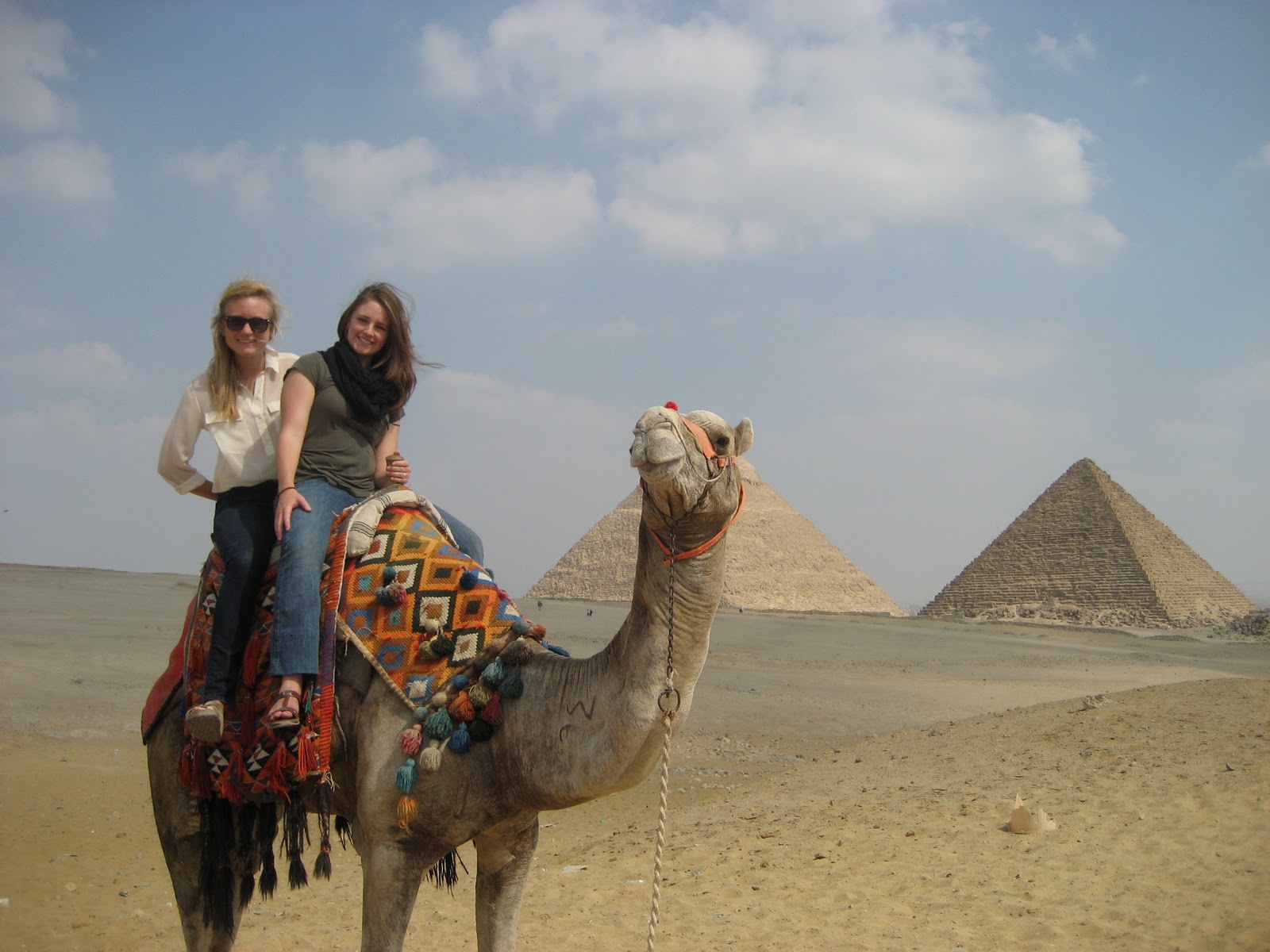
We left pretty early to see they pyramids and the sphinx. When I saw the pyramids from the window of the bus I felt my stomach drop.  They were absolutely amazing. Easily the best part of the trip was the camel ride.  The little boys who led the camels were so much fun and so funny.  
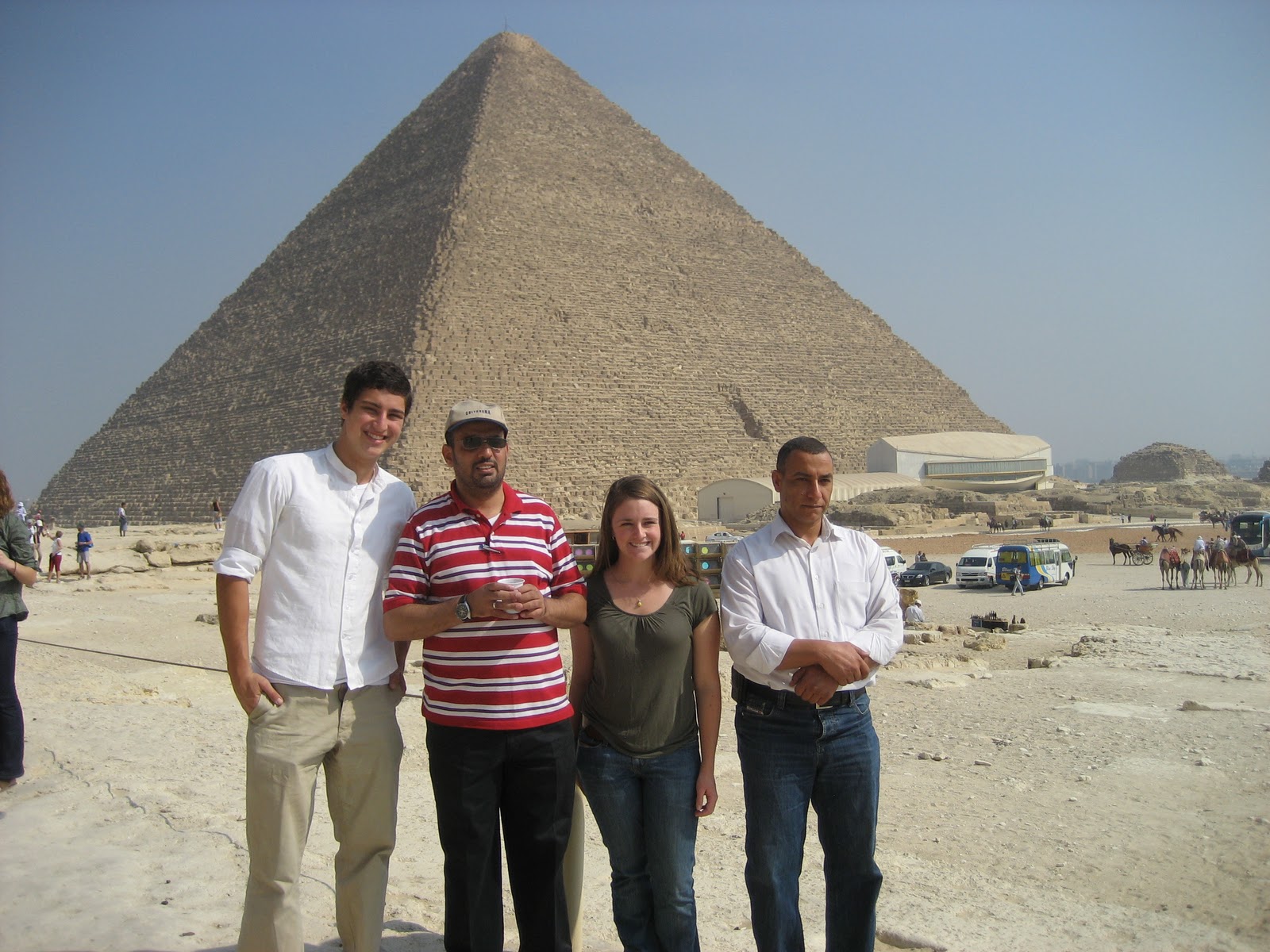
 Joe, Dr. Raed, Ahmed, and myself 


 I love camels! 


After the Pyramids we went to the papyrus factory where we saw the traditional ways of making papyrus. I bought a papyrus scroll to hang in my house. It was a little more expensive than the ones they sold on the street, but this one looked beautiful and I have no confidence that the ones they sold on the street were made of anything more than paper with lines drawn on it. 

Day 4:
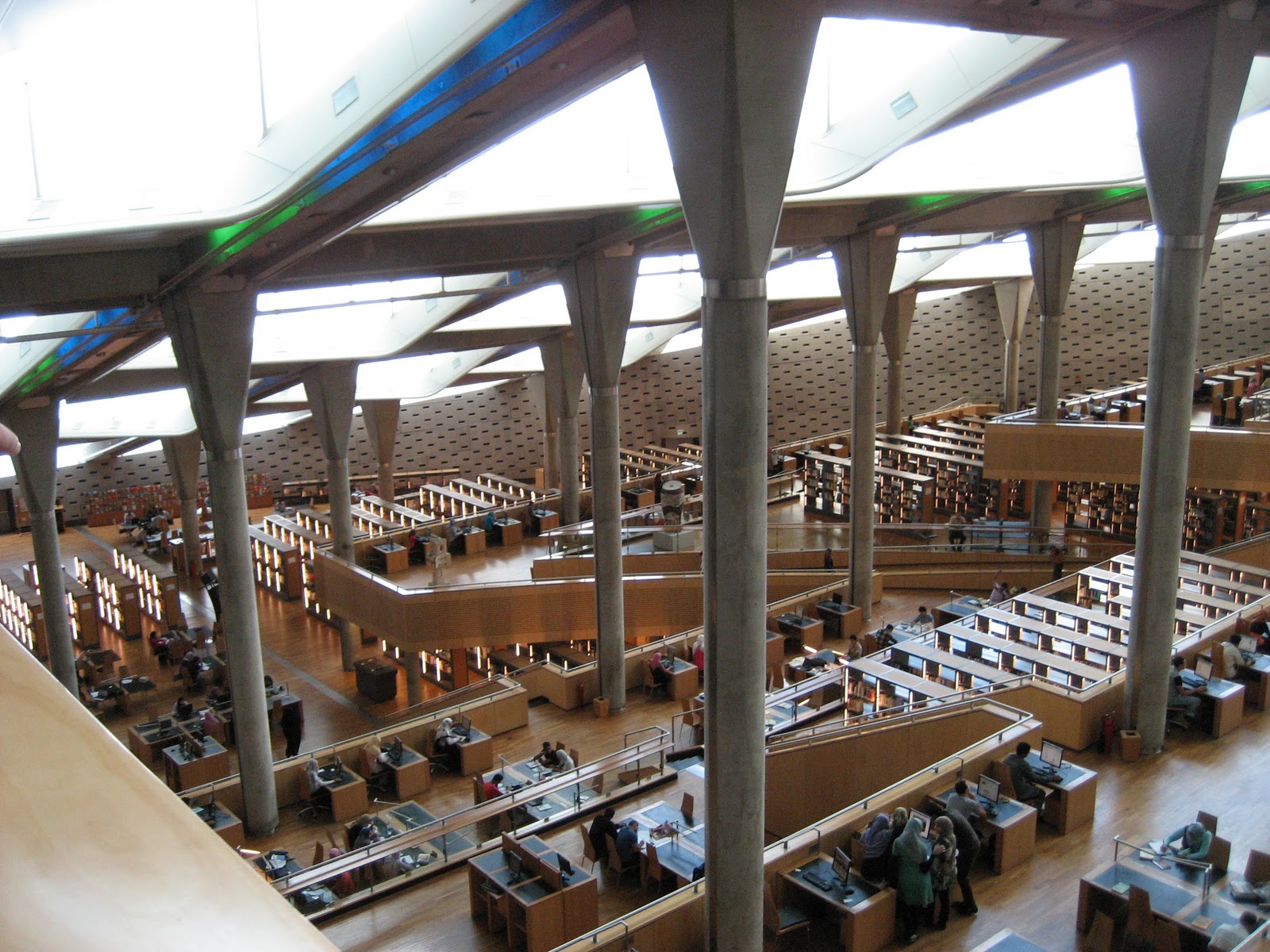
The trip to Alexandria was absolutely exhausting. It was amazing to be in such an old city.  I couldn’t believe that I was walking along the same coast that Cleopatra, Ceasar, Alexander the Great, and Saint Mark walked. I loved the library at Alexandria. It was the most beautiful place I have ever been. I would love to come and study at a library like that. It is a great testament to the original library, one of the wonders of the ancient world. It is really a tragedy that only one of the scrolls is still in existence.

Fishermen on the coast of the Mediterranean 
The most beautiful library in all the land

After the library we went to the Royal Gardens and a little beach. Sitting on the beach and drinking tea while the boys on the trip splashed around in the ocean was a great way to end the day. One of the boys on my trip told me that this was the first time that he had ever seen the ocean. Growing up in California makes you take some things for granted I guess. 

Downtown Alexandria 
Day 5:
We visited the Cultnat center, which is the Center for Cultural and National Heritage Documentation.  They do have a lot of really cool documentation and presentation stuff, including a panorama viewing room that has a lot of really interesting timelines and information about Egyptian history. The program is funded the government. If I was a hungry Egyptian citizen I’m not sure I would be happy that I was paying for such a fancy center. IT looked like something out of the Silicon Valley or some swanky business park in La Jolla. I’d been wondering where the rich business district of Cairo was, and I guess I found out.
 I'm saving these pictures for when I launch my investigation into government spending in the Middle East 
Obviously kidding Government Overlords who might or might not monitor my internet

I took a nap back at the hotel. About 8:00 we went to a place called the Culture Wheel to watch a local band in concert. It was very loud, but I loved it! It was great to see the sort of youth energy and vibe that drove the revolution back in January.

I don’t know if it is because of the size of the city, but Cairo is a much more liberal place than Amman. Men and women socialize freely, and I even met some Muslim girls who didn’t wear a hijab when they  went out, something that would never happen in Amman. The young people I interacted with in Cairo were much more open to talking about politics and government, and a lot more interested in changing things. Hiba and her friends have little to no interest in these issues.

Day 6:
To continue our interaction with people our own age we went to Cairo University. This was one of my favorite parts of the trip. Dr. Raed has connections in the Political Science department at the university, so we met up with a bunch of students who were our same age and studied the same things we did. We got to spend half a day walking and talking with people who were participants in the revolution. All of the students we met had either been protesting at Tahrir square, or had participated on Facebook or in their neighborhoods. How often do you get to hang out with revolutionaries 8 months after the revolution? The students seemed optimistic about the revolution, but were insistent that serious reforms needed to happen before it could be declared a success. I asked the girl in our group if she thought elections were going to be the next critical step and she told me no, a constitution had to come first, how else could you guarantee that the elections were fair? I thought this was a pretty intelligent and insightful answer.
 (I took no pictures this day) 

Day 7:
We had Arabic class in the morning, and then went to explore Coptic Cairo. We were supposed to get an assignment and visit it in groups, but the policeman who accompanied our group everywhere wanted us all to stay together, so we got shuffled from place to place. It was still neat to see some really cool churches, and even a synagogue!
 Cool antiques shop in Coptic Cairo 
The Coptic churches are all in little windy alleyways far away from Caro’s main hustle and bustle, which I think is a testament to the decades of persecution that the Christian people have faced. A lot of the churches were built on top of old walls of other buildings, including secret catacombs where people would worship without anyone finding out.


That night we went on a boat cruise on the Nile. The boats were not fancy, very traditional, but it was really beautiful to be sailing on the Nile at sunset. The cruise was cut a little short because we got stuck in traffic on the way there (surprise).  After dinner we went back to the rooftop café and enjoyed one last night with a view of Cairo.

Day 8:

We checked out of the hotel early and went to the Cairo museum. Cameras are not allowed in the museum, they have x-ray machines to look for cameras in people’s bags. The museum is huge and has a ton of impressive stuff, but it is horribly organized. I have never been to a museum in the US that provides so little information about exhibits. Maybe they were trying to get you to buy a tour, but the few tour groups I pretended to be a part of were hurrying people through the exhibits so fast that I didn’t really think it would be worth it.


The display of King Tutankhamen’s tomb was amazing. I went through a King Tut phase, and it was amazing to see the photos Howard Carter took right next to the things that he took them of! Because I tend to linger in museums, none of my friends were around when I finished. I sat outside for a while and talked with a Coptic Christian Egyptian man who was not a fan of president Obama. He begged me not to vote for him for reelection because “He keeps saying he will do things, and then he does not.” He and I were pretty much on the same page on that one.

Our flight left Cairo and we somehow managed to get 36 people back through customs.  We only have a week of classes left, and then we are going to Dana, Petra, Wadi Rum, and Aqaba for a week. After that, the Independent study period starts. I can’t imagine how easy it is going to be to only have one paper to write. Usually I have to do 3 finals, 3 papers, and debate. Having just one paper is going to be a cakewalk. 

All the best, 
B

Tuesday, October 11, 2011

Off to Cairo

11 October 2011
Amman Jordan
9:15 pm

Greetings,

I haven't written in a while because I haven't done anything interesting. School is distinctly un interesting, and that is all I've don't for the past week or so.

The good news is, that is about to change. Tomorrow I'm leaving at 5:00 am for the airport, when I will then depart to Cairo, Egypt, and I expect things will get real interesting in a hurry.

This week there was a protest in Cairo that resulted in the death of 25 Coptic Christians. Understandably, SIT was a little hesitant to let us go. Humdallah (thanks to God) we got the go ahead yesterday.

I've wanted to visit Egypt since I was in 7th grade and made a model of the Great Pyramid. I remember my teacher being impressed because I was the only student who made his or her model to scale. Seemed like the obvious thing to do to me, and i remember thinking that i couldn't believe i was the only one who thought of that, but I digress (Note: I had similar feelings today during a lecture about sustainable development in Jordan. Some of my classmates are real dumb).

Egypt was my first choice for study abroad, and I'm so happy to get to spend a whole week there! I can't believe I'm going to see the place where the revolution began just a few months ago.

I promise there will be a slew of pictures, but I'm not taking my laptop, so they will have to wait until I get back. Maybe I can sneak a few here or there to keep you anxiously waiting.

سالامي!
B

Friday, September 30, 2011

Madaba, Mount Nebo, and the Dead Sea


30 September 2011
Café De Artists
Rainbow Street
Jabal Amman
5:45 PM

Greetings,

This post should have gone up on Wednesday.  So sue me.  It’s short in order to balance out the novel I just posted.

Today (and by that I mean Wednesday. I'm writing to you from the past) I had a really great day trip with all the SIT people. We started in the town of Madaba where we visited St. George's Church, home to the largest mosaic map of the Holy Land (I know that seems like a small category, but it really is impressive). The map is from the time of the Byzantine Empire and is one of the oldest still in existence. Sadly, only a third of the original remains. The church is full of beautiful mosaics, most of which are more recent, but all of which are painstakingly done by hand. 

The church interior 

 Detail of the map 


After Madaba we went to Mount Nebo, the mountain that Moses climbed to look at the Promised Land before he died. The view was a little clouded by haze and dust, but how cool is it to stand at the same place that Moses stood? Of course, no one knows for sure exactly where Moses was, but ancient tradition is the best we have, and ancient tradition says it was this mountain, and it very well could have been- there aren't exactly a lot to choose from. 

 Alexandra and I at Mt. Nebo. We like to consider ourselves Christian pilgrims, and we plan on taking similar pictures at all the Holy sites we visit. 
The Promised Land 

After Nebo we spent the rest of the day at the Dead Sea. SIT booked us reservations at a private beach (which is good, because I hear the public ones get creepy) that also had a pool and lunch for us. Being in the Dead Sea is a bizarre thing. Not only is it the lowest point on earth (over 400 meters below sea level), it is also the saltiest body of water on the earth- 8.6 times as salty as the ocean. You really do float weightlessly, which is really, really, cool. The salt burning every little cut, hang nail, and- in my case- 23 mosquito bites, is not really very cool. I was in for about 10 minutes before I jumped in the pool. When you get out of the salt water you can feel the grains of salt on your skin- a weird sensation. 
Me, Megan, and Ryan floating 
The Dead Sea got its name because nothing can live in it, but it is also applicable because it is shrinking a meter a year! I was glad I got to see it, because by the time I die it might not even exist! The evaporation makes the salt form sculptures and rocks at the edge of the water. 

 Another sunset pictures

Salt on the edge of the water

All the best, 
Barbara